Tag:
Science
Suitable for today’s 4th July, »Independence Day« in the US, and moreover it being the new moon, we pose the question of the dependency or independency of the Moon. Are we dependent on the Moon or not? And is the Moon dependent on us?
If we believe the surveys, more than 40% of people feel influenced by the Moon, in particular during sleep. In other ways as well and the influence of the Earth’s moon is being discussed in many areas, although there is still no evidence. Science rather confirms the opposite and verifies this by referring to various studies that the human is independent of the Moon; however, this does not correspond with the basic feelings of most.
Read more
Are we alone in the universe? Are there other intelligent forms of life in space or are we alone? These questions have been on mankind’s mind, since we consciously reflect our existence and raise our gaze toward the starlit sky.
With the beginning of space travel, there arose the idea, of sending messages to potential extraterrestrial life. The question, which information is suitable, a representative picture of the entire human race and their lives on planet Earth, is particularly exciting.
Read more
When the sunlight appears on the Moon’s surface in a flat angle, interesting lighting effects are created, due to the mountains and valleys, which can be observed quite well from the Earth. A well-known effect is the so called »golden handle«. This is when the Jura Mountains (»Montes Jura«) are illuminated 4 to 5 days before the full moon and appear as a bright arc, in front of the still darkened Sea of Showers (»Sinus Iridum«) of the Mare Imbrium. This is reinforced by the fact that the boundary of light and shadow, which is called »terminator«, runs directly through this area.
Read more
Luna 2 was a Soviet space probe that impacted the Moon on 13th/14th September 1959. Space probes are unmanned flying objects that are used for exploration. In this case, it was about exploring the Moon, with the goal to fly a human to the Moon and have them return safely. History shows that this did not become possible until ten years later, with the moon landing of Neil Armstrong within the framework of the Apollo 11 mission, in July 1969.
Read more
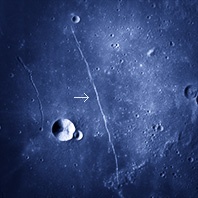
“Rupes Recta” is the name for a long line, which is visible on the Moon’s surface. The name derives from Latin and means “straight fault”, but due to its prominent shape, it is also called “Sword of the Moon”.
Rupes Recta is located at the edge of the lunar mare Mare Nubium and is one of the best known escarpments of the Moon. It is more than 60 miles long, with a width of 1–2 miles and a height of around 800 feet.
Read more
By analogy with earthquakes on Earth, there are so-called “moonquakes” on the Moon. By that, we are referring to tremors on the Moon. The astronauts of the five Apollo missions from 1969 to 1972 left seismographs on the Moon to measure these seismic waves. Afterwards, all data had been sent back to Earth until 1977 and analyzed.
Read more
Even though the idea would be wonderful: this is not about trees that grow on the Moon, but about trees on Earth that grew from seeds, which orbited the Moon exactly 34 times, in a small canister, during the Apollo 14 mission in 1971. For this joint project by NASA and USFS (US Forest Service), the astronaut Stuart Rosa took hundreds of tree seeds with him on this journey. Seeds of five different species of tree had been chosen: loblolly pine, sycamore, sweetgum, redwood and douglas fir. The seeds survived the weightlessness and also when the canister that contained the seeds, got destroyed in the vacuum of the decontamination chamber. The seeds had to be picked up individually after this incident.
Read more
 When looking up to the full moon, you see a sphere and there is no doubt: the Moon has to be round. And we assume quite simply that a sphere is orbiting our Earth. This is correct indeed, if taking a lax approach in the definition of a sphere. The Moon is spherical, but differs considerably from the perfect shape. On the one hand it is flattened at the North Pole and South Pole, and on the other hand, its reverse side, which is turned away from the Earth, is convexed outwardly.
Read more
The exploration of foreign celestial bodies is particularly interesting for science, when there is the possibility of life could exist. An important condition for this provides the evidence of water (mostly in frozen form, because it contains oxygen). One may simply say that where water exists, life could develop, or is already present.
Read more
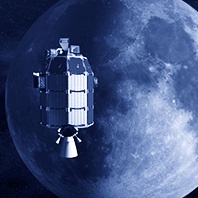
As reported back in September 2013, NASA sent the lunar probe LADEE (short for: Lunar Atmosphere and Dust Environment Explorer) into space, to circle and to explore the Moon. Especially, the formation of ice at the lunar poles has been of great interest. The space probe also collected measurement data of dust particles and gases that are close to the Moon’s surface.
Read more