Tag:
Astronomy
Many people dream about making a journey into space sometime, or setting foot on a celestial body. And despite the fascinating images and movie footages we are able to enjoy here on Earth, the wish remains to experience this sight for ourselves. The German scientist and astronaut Ulrich Walter, recently related that the view onto the Earth in weightlessness and the realization not to be the centre, would change the individual thinking in a profound way. »Up there« in space, he was always happy.
Read more
When the sunlight appears on the Moon’s surface in a flat angle, interesting lighting effects are created, due to the mountains and valleys, which can be observed quite well from the Earth. A well-known effect is the so called »golden handle«. This is when the Jura Mountains (»Montes Jura«) are illuminated 4 to 5 days before the full moon and appear as a bright arc, in front of the still darkened Sea of Showers (»Sinus Iridum«) of the Mare Imbrium. This is reinforced by the fact that the boundary of light and shadow, which is called »terminator«, runs directly through this area.
Read more
When inviscid lava flows out of the volcano, it is possible that cavities are created inside the conduits, due to the different speeds of flow and temperatures. It is like a roof being formed above the flow of lava, which continues to flow inside. After cooling of the rocks, tubular cavities remain.
This phenomenon exists on Earth when volcanoes erupt, and scientists assume that those tubes and cavities could also be prevalent on the Moon, dating from a time when vulcanoes were still active there. The lesser gravity benefited the formation of the tubes and might have also contributed to the fact that there could be kilometer-sized cavities underneath the Moon’s surface.
Read more
Everyone knows that about once a month is full moon … but, strangely enough, a full moon is always on a different day each month and always at a different time. The reason is that the moon month is shorter on the average, than the calendar month. Without being to mathematical, one can say that a moon cycle lasts approx. 29.5 days. This is how the time of full moon spreads irregularly throughout the calender months and it happens (about every 2.5 years) that two full moon dates fall onto the same month, one at the beginning and one at the end of the month. This second full moon is called a “blue moon” today.
Read more
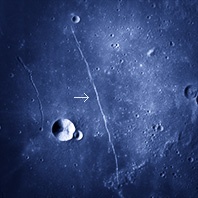
“Rupes Recta” is the name for a long line, which is visible on the Moon’s surface. The name derives from Latin and means “straight fault”, but due to its prominent shape, it is also called “Sword of the Moon”.
Rupes Recta is located at the edge of the lunar mare Mare Nubium and is one of the best known escarpments of the Moon. It is more than 60 miles long, with a width of 1–2 miles and a height of around 800 feet.
Read more
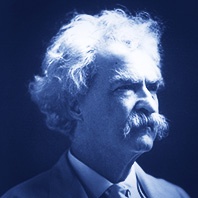
There is a famous quote by the American writer Mark Twain (1835–1910), taken from his satirical travel guide »A Tramp Abroad«, published in 1880: »Everyone is a moon, and has a dark side which he never shows to anybody.« He alludes to the astronomical fact that the Moon only turns one side towards the Earth, due to its synchronous rotation. The reverse side of the Moon remains hidden to us when observed from Earth.
Read more
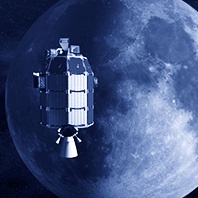
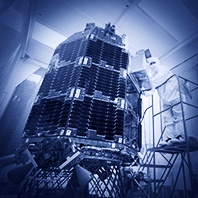
As reported back in September 2013, NASA sent the lunar probe LADEE (short for: Lunar Atmosphere and Dust Environment Explorer) into space, to circle and to explore the Moon. Especially, the formation of ice at the lunar poles has been of great interest. The space probe also collected measurement data of dust particles and gases that are close to the Moon’s surface.
Read more
Again and again it is spoken about the Moon in the night sky, and the visible size for us here from Earth and we would like to recall some details or outline and summarize them again:
The Sun and the Moon about the same size in the sky
The full moon in the sky appears to have almost the same size as the Sun by day, because the Sun is approx. 400 times as large as the Moon, but also 400 times further away. So it balances itself out and this is how these two very different sized orbs appear to be of the same magnitude to us.
Read more
Lions mostly hunt in the dark, as predators have more of an advantage if it is as dark as possible. Hence, the moonlight is a disturbing factor, because it makes the predators easily detectable by their prey. And when the full moon is actually in the sky, it then so happens, that the lions occasionally come away empty-handed. Thus commences a time at full moon (and shortly before), where the lions begin to starve and hence their urge to hunt increases.
Read more
The lunar probe »LADEE« (short for: Lunar Atmosphere and Dust Environment Explorer) of the American space agency NASA, launched successfully into space, for further exploration of the Moon. A probe is an unmanned flying object, which can fly through space or circle orbs and thereby sends data to Earth via radio.
Read more