Sir Charles Spencer Chaplin (1889–1977) is considered one of the first movie stars ever and made film history with his acting and his works. He is also one of the few artists who managed the transition from silent films to sound films.
Because of using archetypal imagery and symbols in his films, it is natural that the moon could also play a part somewhere. We found four references:
Read more
In many languages, inside the word for the weekday »Monday« you find the word »moon«, sometimes slightly modified but mostly easily recognised. This does not appear to be a coincidence. But why? Surely, the Moon cannot only be seen on Mondays and no other good reasons comes to mind quickly why a specific day of the weekly cycle should be connected to the Moon.
Read more
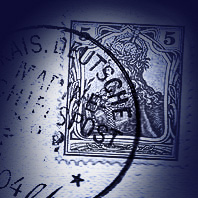
It was about 100 years ago when a special kind of postcard was fashionable in Europe: the moonshine card. This is a kind of postcard with motifs of cities or landscapes that was to convey the effect of a nightly moonshine scenery. It was supposed to be romantic and this obviously appealed to people in those days. There were printed cards as well as photo-postcards that were »dipped into moonlight« in this way.
Read more
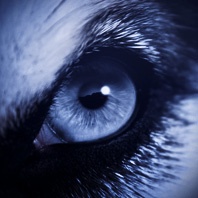 We are approaching a more sinister subject, the werewolf, a being that apparently changes from human into a wolf on the full moon. Everyone has heard about it or seen more or less plausible interpretations in movies. Where does this belief stem from? Why a wolf of all animals? And why in the full moon light?
The word »werewolf« contains, without difficulty to recognise, the »wolf« and the word »were« that translates into »man, human« and can be found in many languages, et al. Old Enlish, Germanic, Old High German and more. So we are talking about a man wolf or a wolfman, someone who can or must take the shape of a wolf. This belief has been widespread in the old days and this had nothing to do with the cliché we are getting to see in horror movies today.
Read more
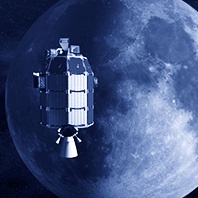
As reported back in September 2013, NASA sent the lunar probe LADEE (short for: Lunar Atmosphere and Dust Environment Explorer) into space, to circle and to explore the Moon. Especially, the formation of ice at the lunar poles has been of great interest. The space probe also collected measurement data of dust particles and gases that are close to the Moon’s surface.
Read more
Maybe it lies within the plan of creation that we are so susceptible to everything that is bigger than what we already know or have already experienced. However, the following merely relates to heavenly bodies …
As we recently wrote in our article »Sun and moon the same size?« here in our full moon blog, the moon changes its distance to earth due to its unusual orbit and subsequently appears to be of a different size for the observer here on earth, depending on how close it is to earth at the time. Is the moon (or another heavenly body) as close to earth as possible, one speaks of perigee, and if it is the furthest away, it is called apogee. You can confidently forget these terms again, however, you may want to memorise that the moon can appear to us in different sizes.
Read more
Quite a lot! The date of Easter is actually determined by the full moon. Quite contrary to Christmas, the Easter date is part of the changing holidays and defined as follows: “Easter is on the Sunday after the first full moon in spring.”
At first glance, this appears to be quite easy: one look at the calendar, beginning of spring is currently on 20th March (though historically or in the future it may also fall on 19th or 21st March) and then simply search for the next full moon and the weekend after will be Easter.
Read more
When observing the Moon, you can see dark spots on its surface. In the old days, these were thought to be the seas and oceans just like on Earth, so they were called »mare« (plural: »maria«). Giovanni Riccioli (1598–1671), an Italian priest and astronomer was leading in this area and was responsible for giving many lunar maria their Latin or partially poetic names. We would like to single out a few that we consider to be worthwhile mentioning.
Read more
 When looking up to the full moon, you see a sphere and there is no doubt: the Moon has to be round. And we assume quite simply that a sphere is orbiting our Earth. This is correct indeed, if taking a lax approach in the definition of a sphere. The Moon is spherical, but differs considerably from the perfect shape. On the one hand it is flattened at the North Pole and South Pole, and on the other hand, its reverse side, which is turned away from the Earth, is convexed outwardly.
Read more
… this line from the poem “Evening Song” from 1778, by the poet Matthias Claudius (1740–1815), belongs to the best-known poems in German literature, not least of all because it was set to music many times; hence, it does not only remain in one’s memory because of its lyrics, but also because of its melody. Especially as a lullaby, everyone has surely heard it before or even sang it to the children:
Read more
Just recently, NASA found out, during an examination of video material, that a relatively large explosion took place on the Moon on 17th March 2013, caused by the impact of a meteoroid. This was an approximately 15 inches large and 88 pounds heavy chunk, which hit the Moon’s surface with 56,000 mph. The explosive power is equivalent to 5 tons of TNT. The flash of light which lit up during the impact in the »Mare Imbrium«, was so bright that it was visible with the naked eye from Earth.
Read more